Home → Statistics → Hit-and-run statistics
Hit-and-Run Statistics: A Nationwide Data Report
Every 43 seconds, a hit-and-run crash occurs somewhere in the United States. Drivers flee accident scenes at an alarming rate, leaving victims without recourse and law enforcement scrambling to identify responsible parties. The consequences range from minor property damage to fatal injuries — and the numbers are getting worse, not better.
This report compiles nationwide hit-and-run data from the National Highway Traffic Safety Administration (NHTSA), the AAA Foundation for Traffic Safety, and other federal sources to provide the most comprehensive overview of hit-and-run crashes in the United States. Data covers crash frequency, fatality trends, contributing factors, state-by-state breakdowns, and the role license plate identification plays in solving these cases.
Key statistics at a glance
| Statistic | Figure | Source |
|---|---|---|
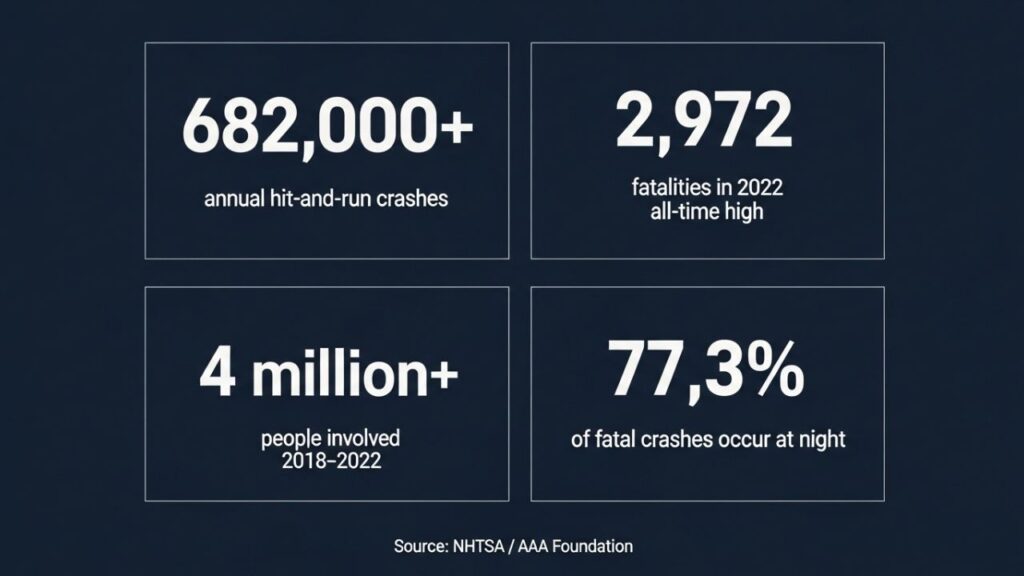
| Average annual hit-and-run crashes | 682,000+ | AAA Foundation |
| Hit-and-run fatalities (2022, all-time high) | 2,972 | NHTSA 2022 |
| Hit-and-run fatalities (2023) | 2,872 | NHTSA 2023 |
| Share of all traffic deaths (2022) | 7% | NHTSA 2022 |
| People involved in hit-and-runs (2018–2022) | 4 million+ | AutoInsurance.com |
| Fatal hit-and-runs occurring at night | 77.3% | ValuePenguin |
| Increase in fatal hit-and-runs over 10 years | 89% | ValuePenguin |
| Hit-and-run crashes per year (2015 peak) | 737,100 | AAA Foundation |
Hit-and-run fatality trends (2015–2023)
Fatal hit-and-run crashes have risen dramatically over the past decade. According to the AAA Foundation for Traffic Safety, the number of people killed in hit-and-run crashes reached an all-time high in 2022 before a slight decline in 2023. Despite that dip, fatalities remain nearly double what they were a decade ago.
The data below tracks annual hit-and-run fatalities from 2015 through 2023, illustrating a trend that has consistently outpaced overall traffic fatality growth during the same period.
| Year | Hit-and-run fatalities | % of all traffic deaths | Change year over year |
|---|---|---|---|
| 2015 | 1,738 | 5.0% | — |
| 2016 | 2,049 | 5.8% | +17.9% |
| 2017 | 2,113 | 6.1% | +3.1% |
| 2018 | 2,183 | 6.3% | +3.3% |
| 2019 | 2,215 | 6.4% | +1.5% |
| 2020 | 2,436 | 6.6% | +10.0% |
| 2021 | 2,893 | 6.8% | +18.8% |
| 2022 | 2,972 | 7.0% | +2.7% |
| 2023 | 2,872 | 6.9% | -3.4% |
Hit-and-run fatalities by year
United States, 2015–2023
Sources: NHTSA 2022; NHTSA 2023; AAA Foundation
Several factors contributed to the sharp increases seen between 2016 and 2022. Researchers point to increased vehicle miles traveled, higher rates of impaired and distracted driving, and a post-pandemic surge in reckless driving behavior. The spike in 2020 and 2021 is particularly notable given that overall vehicle miles traveled actually decreased during the early COVID-19 pandemic period — meaning drivers were fleeing scenes at a higher rate even as roads were less congested.
Night vs. day: when hit-and-runs are most deadly
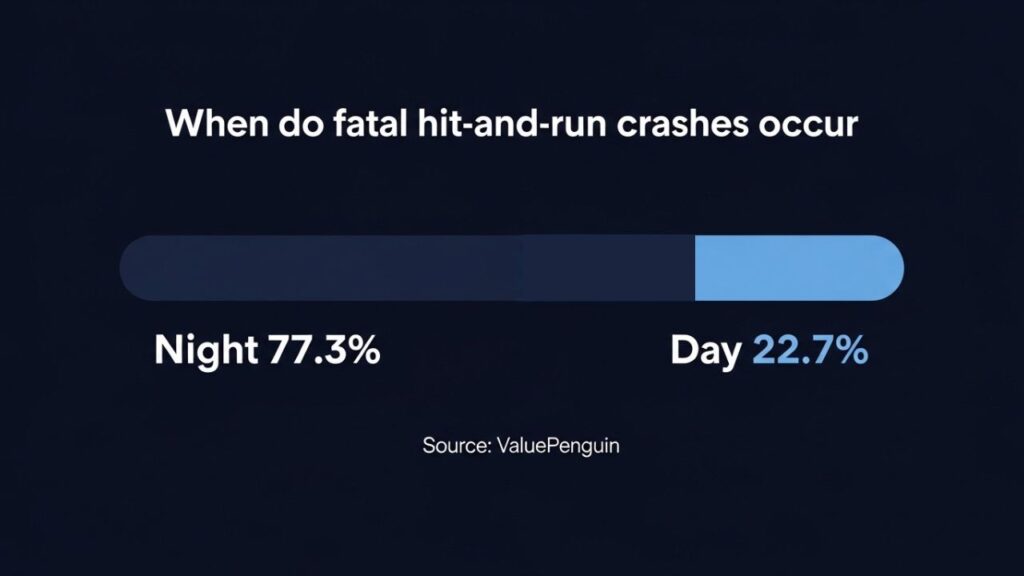
The time of day plays a significant role in hit-and-run fatality rates. According to data analyzed by ValuePenguin covering a 10-year period:
- 77.3% of all deadly hit-and-run crashes occurred at night
- 9.5% of deadly nighttime crashes involved a hit-and-run driver
- Only 2.7% of fatal daytime crashes involved a hit-and-run driver
This disparity reflects the reduced visibility and lower witness presence during nighttime hours, which increases the likelihood that a fleeing driver will go unidentified — making license plate capture at the scene the primary method of identification in many cases.
Hit-and-run crashes by state
Hit-and-run crashes are not evenly distributed across the United States. Certain states consistently report higher rates of hit-and-run incidents due to factors including population density, urban sprawl, road infrastructure, and enforcement levels. The data below draws from NHTSA state-level crash reporting and independent research to identify which states carry the heaviest burden.
States with the highest hit-and-run fatality rates
The following states recorded the highest number of hit-and-run fatalities relative to total traffic deaths, based on the most recent available federal data:
| Rank | State | Hit-and-run fatalities | % of state traffic deaths |
|---|---|---|---|
| 1 | Florida | 267 | 9.8% |
| 2 | California | 337 | 9.6% |
| 3 | Texas | 281 | 8.1% |
| 4 | Georgia | 148 | 8.9% |
| 5 | North Carolina | 122 | 8.4% |
| 6 | Louisiana | 89 | 10.2% |
| 7 | New Mexico | 47 | 10.8% |
| 8 | Nevada | 58 | 9.9% |
| 9 | Arizona | 112 | 9.1% |
| 10 | Tennessee | 98 | 8.6% |
Hit-and-run fatality rates by state
Percentage of total state traffic deaths involving hit-and-run drivers
Source: NHTSA Traffic Safety Facts. Hover over any state to see its rate.
States with the lowest hit-and-run fatality rates
In contrast, several states consistently report lower hit-and-run fatality rates. Smaller populations, lower overall traffic volumes, and stronger enforcement programs are frequently cited as contributing factors.
| Rank | State | Hit-and-run fatalities | % of state traffic deaths |
|---|---|---|---|
| 1 | Vermont | 2 | 2.9% |
| 2 | North Dakota | 3 | 3.1% |
| 3 | Wyoming | 4 | 3.4% |
| 4 | Maine | 5 | 3.6% |
| 5 | Montana | 6 | 3.8% |
Urban vs. rural hit-and-run rates
Geography plays a significant role in hit-and-run frequency. Urban areas account for a disproportionate share of hit-and-run incidents nationwide due to higher traffic density, more pedestrian activity, and greater anonymity for fleeing drivers. Key findings include:
- Urban areas account for approximately 74% of all hit-and-run crashes nationally
- Rural hit-and-run crashes are less frequent but more likely to be fatal due to delayed emergency response times
- Pedestrians and cyclists are disproportionately affected in urban hit-and-run incidents
Understanding which states and environments carry the highest risk underscores the importance of rapid vehicle identification following a crash. A license plate lookup performed immediately after a hit-and-run incident can provide law enforcement and victims with registered owner information, vehicle history, and address data — critical details that can determine whether a case is solved or goes cold.
Contributing factors in hit-and-run crashes
Understanding why drivers flee accident scenes is critical to addressing the problem. Research from the AAA Foundation for Traffic Safety and federal crash data identifies several consistent factors that contribute to hit-and-run behavior nationwide.
Impaired driving
Alcohol and drug impairment is one of the most frequently cited factors in hit-and-run crashes. Drivers under the influence are significantly more likely to flee a scene to avoid detection and criminal charges. Key data points include:
- Alcohol involvement is present in approximately 22% of all hit-and-run fatalities
- Drivers with prior DUI convictions are disproportionately represented in hit-and-run crash data
- Impaired drivers are more likely to flee at night when visibility is lower and witness presence is reduced
Unlicensed and uninsured drivers
Drivers without a valid license or insurance have a strong incentive to flee crash scenes to avoid legal and financial consequences. According to federal data:
- An estimated 13% of all U.S. drivers are uninsured according to the Insurance Information Institute
- States with higher rates of uninsured drivers tend to report higher hit-and-run rates
- Unlicensed drivers are significantly overrepresented in hit-and-run crash reports
Fear of legal consequences
Even licensed and insured drivers sometimes flee scenes out of fear — particularly if they believe they were at fault, were distracted at the time of the crash, or had prior violations on their record. Research suggests that:
- The likelihood of fleeing increases when drivers perceive the crash as serious
- Drivers with prior traffic violations or criminal records are more likely to flee
- Urban environments with lower witness density increase the perceived chance of escape
Distracted driving
In some hit-and-run cases drivers are unaware they struck another vehicle or person, particularly in low-speed incidents or when distracted by a phone or other device. However research indicates that genuine unawareness accounts for only a small fraction of hit-and-run cases — the majority involve a conscious decision to flee.
How license plate lookup helps solve hit-and-run cases
When a hit-and-run occurs, the license plate number is often the only piece of evidence available to identify the fleeing driver. A partial or full plate number captured by a witness, dashcam, or nearby surveillance camera can be the difference between a case being solved and going cold. This section examines how license plate lookup technology and services are used to identify hit-and-run drivers at both the law enforcement and civilian level.
What a license plate lookup can reveal
A license plate lookup queries state motor vehicle databases and public records to return identifying information tied to a registered vehicle. Depending on the method used and the jurisdiction, a lookup can return the following data:
| Data point | Available via public lookup | Available via licensed PI |
|---|---|---|
| Registered owner name | Limited | Yes |
| Current and previous addresses | No | Yes |
| Vehicle make, model and year | Yes | Yes |
| Vehicle history and title status | Yes (via VIN) | Yes |
| Insurance status | No | Yes |
| Prior traffic violations | No | Yes |
| Criminal history flags | No | Yes |
| Known associates | No | Yes |
For hit-and-run victims seeking to identify a fleeing driver, a standard public lookup often returns incomplete data due to privacy protections under the Driver’s Privacy Protection Act (DPPA). The DPPA restricts access to motor vehicle records and limits who can legally request owner information from state DMV databases. Permissible purposes under the DPPA include insurance claims, legal proceedings, and investigations conducted by licensed private investigators.
Automated license plate readers (ALPRs) in hit-and-run investigations
Law enforcement agencies increasingly rely on automated license plate reader technology to identify vehicles involved in hit-and-run crashes. ALPRs are camera systems mounted on patrol vehicles, overpasses, and fixed infrastructure that capture and log license plate data in real time.
Key statistics on ALPR effectiveness include:
- Over 700,000 crimes are solved annually using Flock Safety ALPR technology alone — representing approximately 10% of reported crime nationwide
- Vehicles are involved in 70% of all crimes making plate identification a critical investigative tool
- A single network of ALPR cameras recovered stolen vehicles worth more than $6.5 million according to FBI data
- Hit rates for ALPR scans range from 0.01% to 0.08% — but given the volume of scans processed daily, even low hit rates translate to thousands of identifications per year
The civilian option: license plate lookup services
For hit-and-run victims who cannot wait for law enforcement to complete an investigation — or whose cases have gone cold — a civilian license plate lookup service provides an accessible alternative. These services query publicly available motor vehicle data and proprietary databases to return registered owner information within minutes.
Common use cases for civilian license plate lookups following a hit-and-run include:
- Identifying the registered owner of a vehicle that fled after striking a parked car
- Gathering owner information to share with an insurance adjuster or personal injury attorney
- Verifying vehicle details before filing a police report
- Confirming whether a suspect vehicle matches the description of a fleeing driver
If you have a plate number from a hit-and-run incident, an instant license plate lookup can return registered owner data, vehicle history, and address information to help you move your case forward.
How the lookup process works
Capture the plate number
Record as much of the plate as possible — full plate is ideal but partial plates can still return results in many cases.
Submit the lookup request
Enter the plate number and state into a licensed lookup service. Results are typically returned within minutes.
Review registered owner data
Results include registered owner name, address history, vehicle details, and in some cases insurance and violation data.
Share with law enforcement or your attorney
Provide the registered owner information to police or your personal injury attorney to support your claim or investigation.
Vehicle theft and license plate crimes
Hit-and-run crashes frequently intersect with vehicle theft and license plate related crimes. Stolen vehicles are commonly used in hit-and-run incidents, and stolen or swapped license plates are a known tactic used by drivers to avoid identification. Understanding the scale of vehicle theft in the United States provides important context for why rapid plate identification matters.
Vehicle theft statistics
According to data from the National Insurance Crime Bureau (NICB) and the FBI Uniform Crime Report, vehicle theft remains a significant problem across the United States despite recent declines:
- Approximately 1 million vehicles were stolen in the United States in 2023
- Vehicle theft declined by approximately 17% in 2024 compared to peak levels
- The total value of stolen vehicles exceeds $8 billion annually according to NICB estimates
- Vehicles are involved in 70% of all crimes in the United States
- Kia and Hyundai vehicles accounted for a disproportionate share of thefts in 2022 and 2023 following a viral social media challenge
Sources: NICB; FBI Uniform Crime Report
Stolen plates and plate switching in hit-and-run cases
One of the more challenging aspects of hit-and-run investigations is the use of stolen or switched license plates. Drivers involved in crimes including hit-and-runs sometimes attach stolen plates to their vehicles to throw off identification efforts. Key considerations include:
- A license plate lookup that returns a mismatch between the plate and vehicle description is a strong indicator of plate switching
- Law enforcement cross-references plate data with vehicle make, model, and color to identify mismatches
- ALPR systems are specifically designed to flag plate-to-vehicle mismatches in real time
- Reporting a plate-to-vehicle mismatch to law enforcement immediately following a hit-and-run can significantly accelerate the investigation
Vehicle recovery rates following theft
Recovery rates for stolen vehicles vary significantly depending on how quickly the theft is reported and whether plate identification technology is involved in the recovery effort:
| Recovery method | Recovery rate | Average time to recovery |
|---|---|---|
| ALPR assisted recovery | High | Hours |
| Police report only | Moderate | Days to weeks |
| GPS tracking device | Very high | Hours |
| Civilian plate lookup | Moderate | Hours to days |
| No action taken | Very low | Rarely recovered |
Whether you are dealing with a hit-and-run, a stolen vehicle, or a suspicious plate mismatch, an instant license plate lookup provides immediate access to registered owner data and vehicle history — giving you actionable information when time is critical.
Automated license plate reader (ALPR) crime data
Automated license plate reader technology has become one of the most effective tools in modern law enforcement. ALPR systems capture, log, and cross-reference license plate data in real time — flagging vehicles of interest and generating investigative leads at a scale that manual patrol methods cannot match. The data on ALPR effectiveness makes a compelling case for why plate identification sits at the center of hit-and-run investigations.
How ALPR technology works
ALPR cameras are mounted on patrol vehicles, highway overpasses, parking structures, and fixed roadside infrastructure. Each camera captures license plate images and automatically compares them against databases containing:
- Stolen vehicle records
- Outstanding warrants and wanted persons linked to registered vehicles
- Vehicles of interest in active investigations
- Expired registration and insurance flags
- Amber Alert and missing persons vehicle data
When a plate matches a record in any of these databases the system generates an instant alert to the officer or monitoring station. According to a Congressional Research Service report on ALPR technology, law enforcement agencies use ALPR data for gathering intelligence, identifying potential suspects, and facilitating crime scene analysis.
ALPR effectiveness by the numbers
| Metric | Figure | Source |
|---|---|---|
| Annual crimes solved using Flock Safety ALPR | 700,000+ | Flock Safety |
| Share of reported crime solved via ALPR | ~10% | Flock Safety |
| Stolen vehicles recovered in one FBI study | 1,102 | FBI |
| Value of vehicles recovered in FBI study | $6.5 million+ | FBI |
| Vehicles involved in crimes nationally | 70% | Flock Safety |
| Typical ALPR scan hit rate | 0.01%–0.08% | Brennan Center |
| Secondary crimes related to vehicle theft | 79% property crimes | Colorado DCJ |
Source: Flock Safety
ALPR limitations and the civilian gap
Despite the effectiveness of ALPR technology, significant coverage gaps exist across the United States. ALPR deployment is concentrated in larger urban departments with sufficient budgets — leaving many suburban and rural jurisdictions with limited or no plate reader infrastructure. Key limitations include:
- No standardized national ALPR network exists — coverage varies dramatically by jurisdiction
- Data retention policies vary by state — some jurisdictions delete plate scan data after as little as 30 days
- Hit rates of 0.01% to 0.08% mean the vast majority of scans return no actionable data
- Rural and suburban hit-and-run victims in jurisdictions without ALPR coverage have limited law enforcement plate identification options
For victims in areas with limited ALPR coverage — or in cases where law enforcement resources are stretched — a civilian license plate lookup service fills the gap by providing immediate access to registered owner data without waiting for law enforcement to act.
License plate lookup laws by state
Access to license plate and motor vehicle records in the United States is governed primarily by the Driver’s Privacy Protection Act (DPPA), a federal law enacted in 1994 that restricts who can access personal information from state motor vehicle records and for what purposes. Understanding the legal framework around plate lookups is critical for anyone seeking to identify a hit-and-run driver through official or civilian channels.
What the DPPA covers
The DPPA prohibits state DMVs from disclosing personal information contained in motor vehicle records — including name, address, phone number, and social security number — except for a specific list of permissible purposes. Violations of the DPPA carry civil penalties of up to $2,500 per violation and can result in criminal charges in egregious cases.
Permissible purposes under the DPPA include:
- Use by law enforcement agencies in carrying out official functions
- Use in connection with a civil, criminal, or administrative proceeding
- Use by a licensed private investigator acting on behalf of a client with a legitimate need
- Use by an insurer or insurance support organization in connection with a claim
- Use by an employer to verify commercial driver license information
- Use in connection with a motor vehicle recall or safety research
- Use for legitimate research purposes by academic institutions
State-by-state license plate lookup regulations
While the DPPA sets the federal baseline, individual states have enacted their own motor vehicle privacy laws that in some cases are more restrictive than federal requirements. The table below summarizes the license plate lookup landscape across the 25 most populous states:
| State | Public lookup allowed | PI lookup allowed | DPPA exemptions apply | Additional state restrictions |
|---|---|---|---|---|
| California | Limited | Yes | Yes | Additional privacy protections under CPRA |
| Texas | Limited | Yes | Yes | None beyond DPPA |
| Florida | Limited | Yes | Yes | Florida statute 119.0712 adds restrictions |
| New York | Limited | Yes | Yes | NY Vehicle and Traffic Law applies |
| Pennsylvania | Limited | Yes | Yes | None beyond DPPA |
| Illinois | Limited | Yes | Yes | None beyond DPPA |
| Ohio | Limited | Yes | Yes | None beyond DPPA |
| Georgia | Limited | Yes | Yes | None beyond DPPA |
| North Carolina | Limited | Yes | Yes | None beyond DPPA |
| Michigan | Limited | Yes | Yes | None beyond DPPA |
| New Jersey | Limited | Yes | Yes | NJ Motor Vehicle Commission restrictions apply |
| Virginia | Limited | Yes | Yes | None beyond DPPA |
| Washington | Limited | Yes | Yes | Washington Privacy Act adds restrictions |
| Arizona | Limited | Yes | Yes | None beyond DPPA |
| Tennessee | Limited | Yes | Yes | None beyond DPPA |
| Massachusetts | Limited | Yes | Yes | MA Data Privacy Law adds restrictions |
| Indiana | Limited | Yes | Yes | None beyond DPPA |
| Missouri | Limited | Yes | Yes | None beyond DPPA |
| Maryland | Limited | Yes | Yes | None beyond DPPA |
| Colorado | Limited | Yes | Yes | Colorado Privacy Act adds restrictions |
| Wisconsin | Limited | Yes | Yes | None beyond DPPA |
| Minnesota | Limited | Yes | Yes | Minnesota Government Data Practices Act applies |
| South Carolina | Limited | Yes | Yes | None beyond DPPA |
| Alabama | Limited | Yes | Yes | None beyond DPPA |
| Louisiana | Limited | Yes | Yes | None beyond DPPA |
Why public lookups return limited data
Many people attempting to identify a hit-and-run driver discover that free or public license plate lookup tools return only basic vehicle information — make, model, year, and state of registration — without revealing the registered owner’s name or address. This is a direct result of DPPA restrictions on DMV data disclosure to the general public.
The practical implication is that civilians seeking full registered owner data following a hit-and-run have two primary legal options:
- File a police report and request that law enforcement conduct an official DMV query on their behalf
- Use a licensed plate lookup service that operates under DPPA permissible purpose exemptions to access full registered owner data legally and compliantly
It is important to note that attempting to obtain motor vehicle records outside of DPPA permissible purposes — including purchasing data from unauthorized sources or misrepresenting your purpose to a DMV — carries significant legal risk including civil liability and potential criminal charges.
Penalties for hit-and-run drivers by state
Hit-and-run penalties vary significantly by state and by the severity of the incident. The table below outlines penalties across the ten states with the highest hit-and-run fatality rates:
| State | Property damage only | Injury involved | Fatality involved | Max prison sentence |
|---|---|---|---|---|
| Florida | Misdemeanor | Felony | 1st degree felony | 30 years |
| California | Misdemeanor | Felony | Felony | 4 years |
| Texas | Misdemeanor | Felony | 2nd degree felony | 20 years |
| Georgia | Misdemeanor | Felony | Felony | 5 years |
| North Carolina | Misdemeanor | Felony | Felony | 39 months |
| Louisiana | Misdemeanor | Felony | Felony | 10 years |
| New Mexico | Misdemeanor | Felony | 3rd degree felony | 3 years |
| Nevada | Misdemeanor | Felony | Category B felony | 20 years |
| Arizona | Misdemeanor | Felony | Class 3 felony | 8.75 years |
| Tennessee | Misdemeanor | Felony | Class D felony | 12 years |
The severity of these penalties underscores why fleeing drivers are motivated to avoid identification — and why rapid license plate lookup following an incident is so critical for victims seeking accountability.
What to do after a hit-and-run
Being involved in a hit-and-run is a disorienting experience. Acting quickly and methodically in the immediate aftermath significantly increases the chances of identifying the fleeing driver and recovering damages. The following step-by-step guide draws on law enforcement recommendations and legal best practices for hit-and-run victims nationwide.
Immediate steps at the scene
Check for injuries and call 911
Your safety and the safety of any passengers is the first priority. Call 911 immediately regardless of whether injuries are apparent — some injuries are not immediately visible and a police report is essential for any subsequent insurance claim or legal action.
Record the license plate number immediately
If you can safely observe the fleeing vehicle write down or photograph the license plate number before it disappears from view. Even a partial plate — the first three characters or the last three — can be enough to narrow down a vehicle in a database search.
Document vehicle details
Note the make, model, color, and any distinguishing features of the fleeing vehicle such as damage, bumper stickers, or aftermarket modifications. This information helps cross-reference plate lookup results and confirms a plate-to-vehicle match.
Gather witness information
Ask any bystanders or nearby drivers if they witnessed the incident and if so collect their names and contact information. Witnesses may have captured additional details including a clearer view of the plate number or the driver.
Look for surveillance cameras
Scan the immediate area for traffic cameras, business security cameras, doorbell cameras, or dashcams on nearby parked vehicles. Surveillance footage can capture plate numbers and driver details that witnesses may have missed. Note the locations and report them to responding officers.
Photograph all damage and the scene
Document all vehicle damage, road conditions, skid marks, debris, and the surrounding area with your phone camera. This evidence supports your insurance claim and any subsequent legal action.
Steps to take in the hours following the incident
File a formal police report
If police did not respond to the scene file a formal report at your local police department or online through your jurisdiction’s reporting portal. A police report number is required by most insurance companies to process a hit-and-run claim.
Run a license plate lookup
If you captured the plate number use an instant license plate lookup to obtain registered owner data including name, address history, and vehicle details. Provide this information to law enforcement and your insurance company to accelerate the identification process.
Notify your insurance company
Contact your insurance provider as soon as possible after the incident. Most policies cover hit-and-run damage under uninsured motorist coverage. Provide your police report number, photos, witness information, and any plate lookup results you have obtained.
Consult a personal injury attorney
If you sustained injuries or significant property damage consult a personal injury attorney who specializes in vehicle accidents. An attorney can advise on your legal options, assist with insurance negotiations, and pursue civil action against an identified hit-and-run driver.
What if the driver is never identified
Unfortunately not all hit-and-run cases are solved. When a fleeing driver cannot be identified victims still have options for recovering damages:
- Uninsured motorist coverage on your own policy typically covers hit-and-run damage and injuries even when the driver is not identified
- State crime victim compensation funds may cover medical expenses in cases involving injury
- If new evidence emerges — including a plate number obtained later from a witness or surveillance footage — a case can be reopened even months after the incident
- Cold case hit-and-run investigations have been solved years later using ALPR historical data and civilian tip lines
If your hit-and-run case has gone cold and you have a plate number that has not yet been looked up an instant license plate lookup may still return actionable registered owner data to help move your case forward.
Summary: hit-and-run statistics and license plate lookup
Hit-and-run crashes represent one of the most serious and growing problems on American roads. The data compiled in this report paints a clear picture of the scale and trajectory of the problem:
- Over 682,000 hit-and-run crashes occur annually in the United States
- Fatal hit-and-run crashes reached an all-time high of 2,972 in 2022 — an 89% increase over a decade
- 77.3% of deadly hit-and-run crashes occur at night when identification is most difficult
- Impaired, unlicensed, and uninsured drivers account for the majority of fleeing behavior
- ALPR technology solves over 700,000 crimes annually but coverage gaps leave many victims without law enforcement plate identification resources
- The DPPA restricts public access to registered owner data — making a licensed lookup service the fastest legal option for civilians seeking to identify a hit-and-run driver
The single most important action a hit-and-run victim can take — beyond calling 911 — is capturing the fleeing vehicle’s license plate number. That number, when run through a licensed lookup service, can return the registered owner’s name, address history, and vehicle details within minutes — information that can determine whether a case is solved or goes cold.
Frequently asked questions
How many hit-and-run crashes happen every year in the United States?
According to the AAA Foundation for Traffic Safety, an average of 682,000 hit-and-run crashes occur per year in the United States. The peak year on record was 2015 with 737,100 reported crashes.
How many people die in hit-and-run crashes each year?
According to NHTSA data, 2,872 people were killed in hit-and-run crashes in 2023. The all-time high was 2,972 fatalities recorded in 2022, representing 7% of all traffic deaths that year.
Which state has the highest hit-and-run rate?
New Mexico records the highest hit-and-run fatality rate as a percentage of total traffic deaths at 10.8%, followed by Louisiana at 10.2% and Florida at 9.8%. California records the highest absolute number of hit-and-run fatalities due to its large population and high vehicle miles traveled.
Can I look up a license plate myself after a hit-and-run?
Yes. While free public lookup tools return limited data due to DPPA privacy restrictions, a licensed plate lookup service can legally return registered owner name, address history, and vehicle details under permissible purpose exemptions. An instant license plate lookup can return results within minutes of submitting a plate number and state.
What information does a license plate lookup return?
A licensed plate lookup can return the registered owner name, current and previous addresses, vehicle make model and year, vehicle history and title status, and in some cases insurance status and prior violations. The depth of results depends on the state and the lookup service used.
Is it legal to look up a license plate after a hit-and-run?
Yes. Looking up a license plate for the purpose of identifying a driver involved in a crash is a permissible purpose under the federal Driver’s Privacy Protection Act. Using a licensed lookup service ensures the query is conducted legally and compliantly within DPPA guidelines.
What should I do if I only got a partial plate number?
A partial plate number is still valuable. Even three or four characters combined with the vehicle make, model, color, and state can significantly narrow down possible matches in a database search. Submit whatever plate information you have along with vehicle details when running a lookup — and provide all available information to responding law enforcement officers.
Do you have a plate number from a hit-and-run?
Run an instant license plate lookup to identify the registered owner, address history, and vehicle details — results returned within minutes.
Run a License Plate LookupConducted legally under DPPA permissible purpose guidelines
Data sources and methodology
The statistics compiled in this report are drawn from the following primary sources. All data points are linked inline throughout the article to their original source publications.
- National Highway Traffic Safety Administration (NHTSA) — Traffic Safety Facts
- AAA Foundation for Traffic Safety — Hit-and-Run Research Briefs
- ValuePenguin — Hit-and-Run Crash Analysis
- AutoInsurance.com — Hit-and-Run Research
- Flock Safety — ALPR Crime Solving Data
- FBI — License Plate Reader Technology and Stolen Vehicle Recovery
- Brennan Center for Justice — Automated License Plate Readers
- Congressional Research Service — Law Enforcement and ALPR Technology
- Colorado Division of Criminal Justice — ALPR Research Brief
- National Insurance Crime Bureau (NICB) — Vehicle Theft Data
- Insurance Information Institute — Uninsured Motorist Data
- Driver’s Privacy Protection Act (DPPA) — Federal Statute